The Onion Algorithm used by the ARA™ UHP Sprayer is setting a new standard in sustainable agriculture. For onion growers, their benefits are great especially when it comes to minimizing phytotoxicity.
Scan and detect weeds with Artificial Intelligence (AI)
Our advanced Plant-by-Plant AI™ technology detects weeds of sub-centimeter size in your onion crop, even in the onion rows. It targets them in less than 1/4 of a second on a footprint as small as 6 by 6 cm.
Our advanced Plant-by-Plant AI™ technology detects weeds of sub-centimeter size in your onion crop, even in the onion rows. It targets them in less than 1/4 of a second on a footprint as small as 6 by 6cm.
Visible Results
Phytotoxicity and weed pressure both impact yield quantity. In the example below ARA proves it doesn't just do the job, it actually gets better results than standard broadcast spraying
No herbicides are applied—used as a control in tests. Weak yield results due to uncontrolled weed pressure.
Non-Treated (Class mm)
AI targets specific weeds, spraying only them with selective herbicides. Result shows a higher yield than broadcast spraying.
ARA, Selective (Class mm)
AI sprays only weeds with non-selective herbicides, avoiding crops. Result shows a higher yield than broadcast spraying.
ARA, Non-Selective (Class mm)
Herbicides are sprayed evenly across an entire field, covering both weeds & crops. Weed pressure is controlled, but yield suffered from phytotoxicity.
Broadcast Spraying (Class mm)
We sprayed 20 acres with a total of 60 gallons. Normally we would use about 1,000 gallons to cover the whole field. We used 1 ounce of active ingredient across the whole field where we usually would use 16 ounces. While using ARA, the onions had really good color and really good shape, totally unaffected by the spray.
— Cody Anderson USA L & L Ag Production, LLC, Onion Grower
Up to 95% Reduction in Plant Protection Product Use
ARA precisely applies herbicides, insecticides, and fertilizers only where needed.
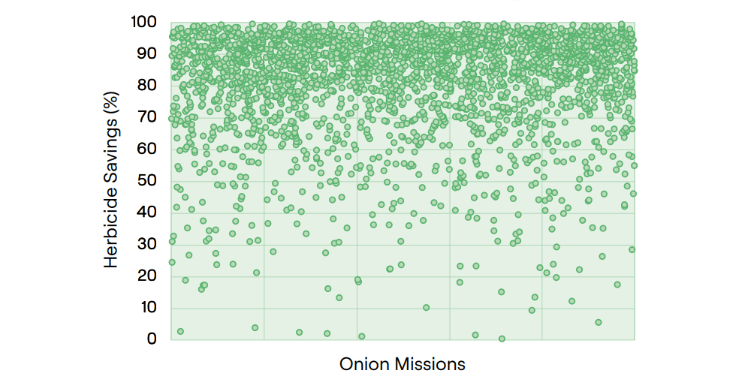
Our study, which analyzed nearly 3,000 ARA sprayer missions in onion fields, reveals that ARA saved nearly 80% of herbicide per hectare in 2023 compared to conventional broadcast spraying. Furthermore, ARA efficiently eliminated weeds while reducing the phytotoxic effects of chemical inputs, ensuring higher yields per hectare compared to both conventional application and untreated control.
UntreatedControl
No treatment applied. Onions and weeds are in direct competition for soil nutrients, water and light.
Broadcast Conventional Treatment
Broadcast treatment applied. Onion plants are weakened by the contact with the herbicides. (result shows 7 days after treatment)
ARA Spot Spray Treatment
Onion plot treated with ARA. Precise spraying ensures clean rows and vigorous, healthy crops.(result shows 7 days after treatment)
Each dot shows the herbicide saving for each single mission ARA led in onions in 2023.
Proven Benefits
-> Higher yield potential – By avoiding phytotoxicity, onions grow stronger and bigger.
-> Environmentally Sustainable – Reduce chemical runoff, improve soil health and air pollution.
Upgrade Your Spraying
Get in touch with us to find the right solution for your needs. With ARA units operating in over 20 countries, you’ll be joining a growing global community transforming agriculture!
Ready to See ARA in Your Fields?
Test our AI-powered spot-sprayer on your crops and see what one pass can already do for your bottom line.
The Plant-by-Plant artificial intelligence technology (AI) is now being expanded to support a wide range of cabbage types, bringing Ultra-High Precision weed control to some of the most delicate and diverse crops.
The Challenge: Weed Control in Mixed Cabbage Fields
Cabbage crops present a unique challenge: different shapes, growth habits, and leaf textures make selective weeding difficult, especially in organic or reduced-input systems. These complexities often lead to input waste and crop damage when using traditional broadcast spraying. To overcome this, Ecorobotix applies Ultra-High Precision AI, treating only what’s necessary, while protecting each plant individually.
The Solution: Advanced AI for Complex Crops
Our new Various Cabbages Algorithm identifies a wide range of cabbage types, enabling selective treatment of weeds, even when they grow closely beside valuable crop heads. With real-time image recognition and a 6×6 cm print, the ARA™ system applies only what is needed, exactly where it is needed. The algorithm will support the following cabbage types:
How ARA™ is Helping Broadacre Ukraine Farmer Manage Weeds Field by Field
Experience Usecase
More Than 100 ARA™ Sprayers in U.S. Onion Fields: The Rise of Targeted Weed Control
Research & Development
Precision Weed Control with ARA™ Helping to Protect Kentucky Bluegrass Seed Quality
Research & Development
ARA™ Precision Sprayer Cuts Herbicide Application by 84% in Tall Fescue Trial
Experience Usecase
ARA Sprayer revolutionises weed control for Australian veggie grower
Experience Usecase
How an ARA™ Sprayer Transformed Rumex Control in France
Press Release
Ecorobotix Demonstrates Major Cost Savings and Effective Weed Control in California Cotton
Research & Development
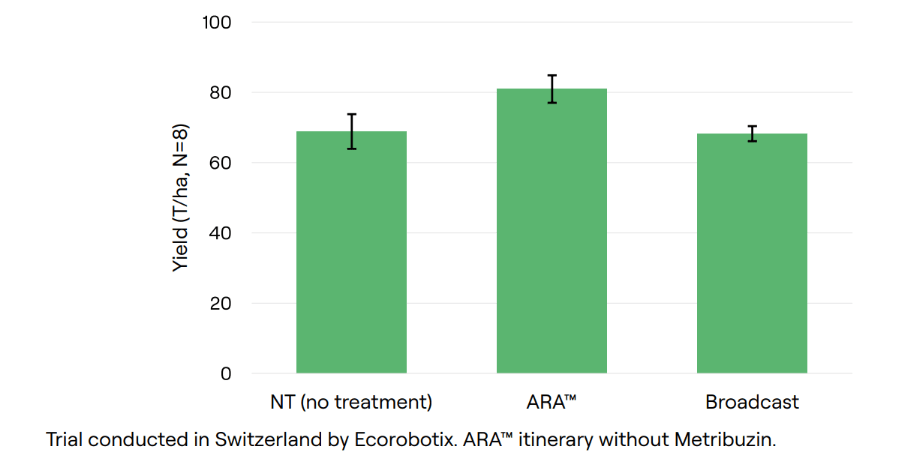
Facing weeding without metribuzin in carrots
Carrot
Changing Carrot Farming Forever !
Our award-winning algorithm is revolutionizing the way farmers weed and treat carrot fields. ARA™ optimises weed control by limiting herbicide applications and reducing the need for manual labour.
Precise weed control in carrots with AI
Our Artificial Intelligence Plant-by-Plant AI™ treats weeds with just a spot size of 6 by 6 cm in your carrot crop. Our advanced technology scans, detects and sprays them within milliseconds.
Sub-centimeter plant detection of all weeds Red: targeted weeds. Green: crop
Sub-centimeter plant detection of voluntary potatoes
In some cases, we replace one or two broadcast herbicide applications with an ARA treatment, in order to reduce stress on the crop. Previously, hand weeding was considered an emergency measure: today, it is only very rarely required, since problematic weeds can be efficiently targeted and eliminated earlier using ARA.
— Dennis Großhans, Germany Vegetable Grower
Up to 95% Reduction in Plant Protection Product Use
ARA precisely applies herbicides, insecticides, fertilizers and biostimulants only where needed.
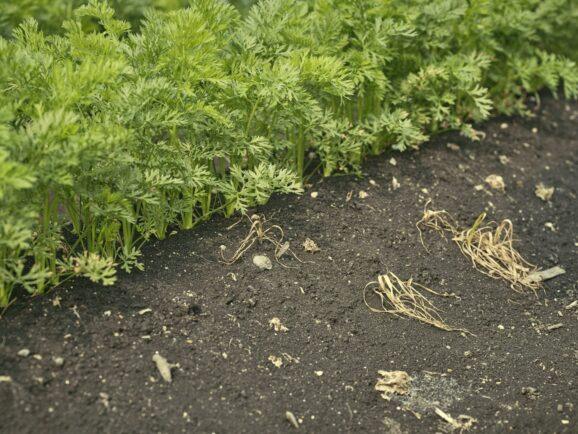
Comparison between carrot plots treatment with ARA compared to ‘no treatment’. Thanks to highly precise application your carrot fields are cleared from weeds, leaving behind strong carrots.
Untreated Control
ARA™ Spot Spray, 10 days after treatment
Broadcast
ARA™
Maximise Your Carrot Yields
Increased biomass production is indicated by the earlier closure of crop rows in the ARA treatments compared with broadcast treatment. This observation suggests a tendency toward higher yields in the ARA treatments.
Proven Benefits
-> Volume savings
-> Reduce Phytotoxicity
-> Really good weed control up to 5 leaves in herbicide program without metribuzin
-> More biomass
-> Tendency to better yield
-> Good solution for fighting field morning glory and volunteer potato in carrots
Note: Any use of plant protection products must comply with the official authorisations, authorised conditions of use, and applicable regulations in the country of use.
Carrot Farming with Award-Winning Precision
Discover how Ecorobotix’s ARA sprayer and its new carrot algorithm—winner of the LAMMA 2025 Silver Award—reduce plant protection products by up to 95%.
Get in touch with us to find the right solution for your needs. With ARA units operating in over 20 countries, you’ll be joining a growing global community transforming agriculture!
Ready to See ARA in Your Fields?
Test our AI-powered spot-sprayer on your crops and see what one pass can already do for your bottom line.
Revolutionizing Lettuce Farming. Following extensive field testing, our cutting-edge technology is transforming the way farmers cultivate lettuce crops.
The Challenge: Precise Weed Control in Lettuce Fields
Lettuce farming demands high precision. In the U.S., where lettuce is often seeded, growers face significant costs from manual weeding and broad plant protection product applications. These practices can lead to increased phytotoxicity and reduced crop quality. In Europe, where lettuce is typically transplanted, the main challenge lies in the precise application of insecticides and fungicides to protect young plants without harming them.
The Solution: Plant-by-Plant AI
Ecorobotix’s advanced plant-by-plant AI redefines targeted weed control, ensuring only unwanted weeds are treated with exceptional accuracy. This technology optimizes crop health, reduces plant protection product costs, and enhances yield quality.
Rear view of man in beige shirt walking along cabbage field while working at plantation
About ten days after planting lettuce, I applied fungicide. The lettuce was quite small. Thanks to ARA™, I was able to save around 80% of the product.
— Martin Van Winden, Ferme Hotte & Van Winden, Canada
Lettuce Farming with Ultra High Precision
Learn how Ecorobotix’s ARA™ sprayer and its groundbreaking lettuce algorithm help reduce plant protection product use by up to 80%, ensuring healthier crops and more sustainable farming.
How ARA™ is Helping Broadacre Ukraine Farmer Manage Weeds Field by Field
Experience Usecase
More Than 100 ARA™ Sprayers in U.S. Onion Fields: The Rise of Targeted Weed Control
Research & Development
Precision Weed Control with ARA™ Helping to Protect Kentucky Bluegrass Seed Quality
Research & Development
ARA™ Precision Sprayer Cuts Herbicide Application by 84% in Tall Fescue Trial
Experience Usecase
ARA Sprayer revolutionises weed control for Australian veggie grower
Experience Usecase
How an ARA™ Sprayer Transformed Rumex Control in France
Press Release
Ecorobotix Demonstrates Major Cost Savings and Effective Weed Control in California Cotton
Research & Development
Facing weeding without metribuzin in carrots
Lettuce Thinning
Uniform Lettuce, Zero Guesswork: Meet AI Thinning
The Challenge: Manual Lettuce Thinning Is Costly, & Often Inconsistent Across The Field
Thinning refers to the selective removal of young plants seeded at high rates, to allow crop adequate spacing and optimal growth. Lettuce thinning is a labor-intensive, time-sensitive task that traditionally requires large field crews and results in inconsistent spacing due to human variability (Chu et al. 2016). Rising labor costs, crew shortages, and the need for greater precision in crop management make manual thinning an increasingly unsustainable solution for commercial lettuce producers.
The Solution: Plant-by-Plant AI
Ecorobotix’s ARA Lettuce Thinning algorithm offers a smarter, faster, and more precise alternative to manual thinning. Using high-resolution cameras combined with Artificial Intelligence (AI), ARA identifies each lettuce plant individually and determines optimal spacing with sub-inch accuracy. This ensures uniform stands and reduces the burden of manual labor. The system operates with a single driver, dramatically reducing labor costs and time in the field. Existing ARA owners can easily activate thinning through a software license—no new equipment and no technical adjustments, such as nozzle position depending on row number or spacing, are needed.
Case study in Californian lettuce: ARA vs. manual thinning
For instance, ARA reduces thinning operational costs by 65% compared to manual labor.
Thinning
Workers
Time/acre
Cost/acre*
Manual
29
15 min
$117
ARA
1
15 min**
$38 (incl. $5.4 labor costs)***
* using an equipment operator wage rate of $21.70/hour and field labor rate of $16.10/hour (Mosqueda et al. 2017) ** based on a speed of 2 mph, a 6 m working width, and an additional 20% margin *** including a material consumption of 8 gallons/acre (Suppress used at 9% costing $45/gallon)
Why Choose Ecorobotix' ARA UHP Sprayer?
Besides being a reliable weeding solution in different crops, ARA offers unique features and possibilities.
Flexibility
By selecting the optimal and minimum spacings, the operator has the entire control of the plant selection process. These settings allow to adapt the thinning to each field according to the seeding, the emergence quality and the desired plant density. By lowering the minimum spacing, farmers can choose to increase the flexibility in plant choice, optimizing the density of kept crops.
All-in-one solution
While other AI thinning technologies do not address the issue of multiple plants (two or more closely seeded plants overlapping), ARA goes a step further: once the multiplant removal option is activated, plants that are too close together to be individually sprayed can now be accurately detected and eliminated. Thus, the number of multiple plants remaining after thinning can be reduced by up to 85%1 compared to competing technologies, achieving results comparable to manual thinning.
ARA can operate at speeds up to 3.5 mph while thinning covering 8 acres per hour. ARA thinning technology uses significantly less herbicides than competing systems (Mosqueda et al. 2017), averaging only 8 gallons per acre in lettuce2.
The sooner the better
To maximize thinning accuracy and efficiency with our spraying technology, it is recommended to intervene before leaf overlaps occur between plants. Ecorobotix’s models are trained to recognize the crop from the one–true leaf stage, enabling earlier operations in the field. Moreover, early-stage applications allow for greater chemical savings, as lower doses and spray volumes are sufficient to thin lettuce effectively.
With the ability to thin, weed, and treat crops, ARA becomes a versatile tool that maximizes return on investment (ROI) and operational efficiency.
Depending on seeding distance, row number, and selected parameters ↩︎
References
Chu Q, Liu J, Bali K, et al (2016) Automated thinning increases uniformity of in-row spacing and plant size in Romaine lettuce. HortTechnology 26:12–19
Mosqueda E, Smith R, Goorahoo D, Shrestha A (2017) Automated lettuce thinners reduce labor requirements and increase speed of thinning. Calif Agric 72:. https://doi.org/10.3733/ca.2017a0018
Lettuce Farming with Ultra High Precision
Learn how Ecorobotix’s ARA sprayer and its groundbreaking lettuce algorithm help reduce plant protection product use by up to 80%, ensuring healthier crops and more sustainable farming.